UAE banking looks easy from the outside. You move to Dubai, open an account, and get on with life. That is how it works in the UK. In the UAE, it does not work that way.
The gap between expectation and reality catches a lot of UK professionals off guard, sometimes at the worst possible moment. If you arrive without an Emirates ID, without a salary certificate, without the right company paperwork, or without knowing the minimum balance rules, you may spend weeks unable to receive money, pay rent, or access funds you transferred from the UK. Getting your UAE residence visa sorted first gives you the base everything else depends on, including banking.
This article looks at what is actually different about UAE banking, what the requirements are, which banks suit UK expats, and what to sort out before you arrive.
What is different about UAE banking
UK banking is built around consumer access. Competition law, regulatory pressure, and decades of retail banking infrastructure mean you can usually open a current account fast, often for free, and sometimes within days.
UAE banking is built around credit risk management. Banks here start cautious. They want to know who you are, where your income comes from, how much it is, and whether you are legally resident in the UAE before they open the door.
That means account opening is slower, needs more documents, and can be genuinely difficult for new arrivals, non-residents, or anyone whose income does not fit the usual salary certificate model.
It is not that UAE banks dislike expats. Most people in the UAE are expats. The issue is that the paperwork is tighter, the compliance checks are stricter, and problems with the wrong bank or account type often show up later.
The Emirates ID requirement
The biggest blocker for UK arrivals opening a UAE bank account is the Emirates ID.
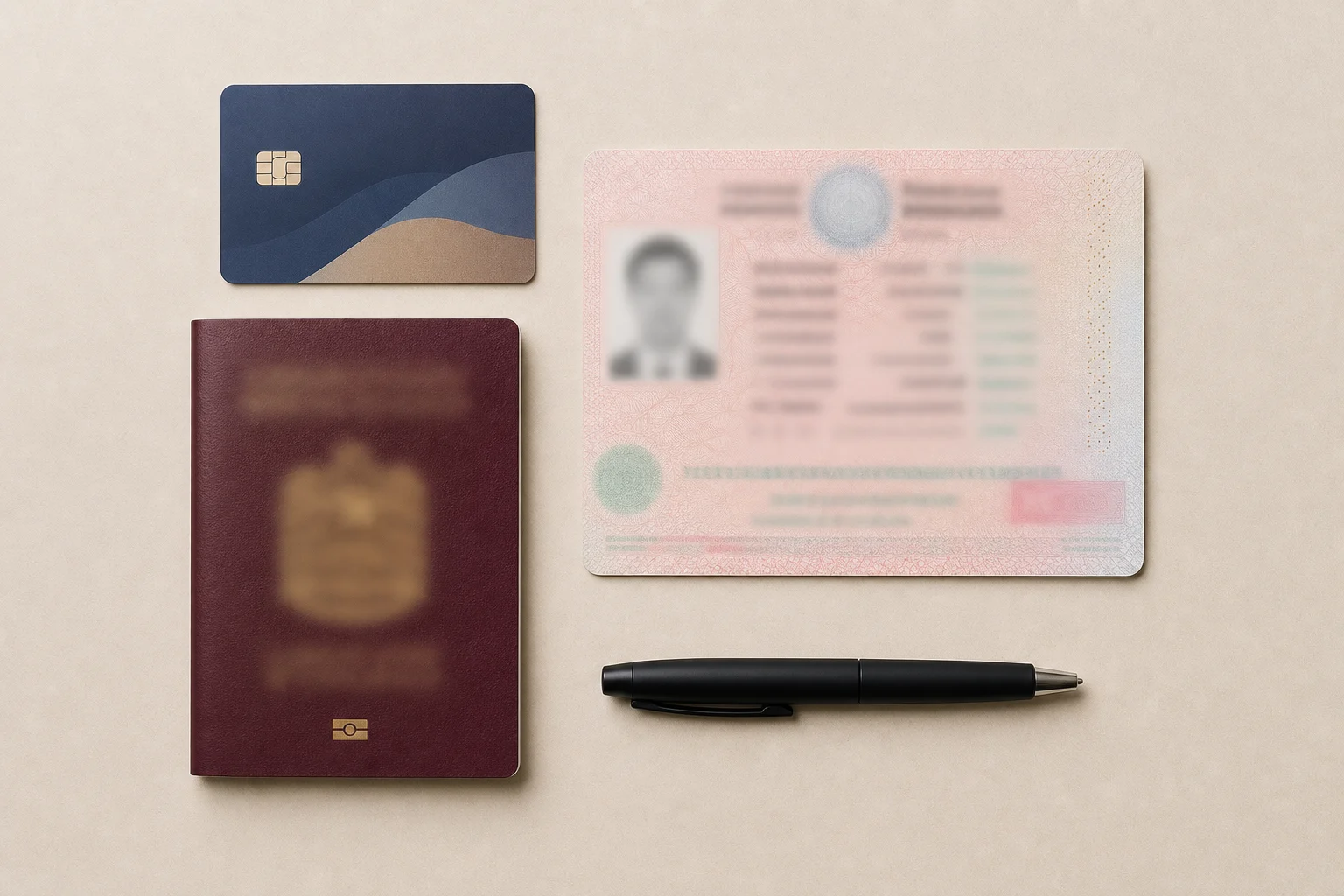
Every major UAE retail bank asks for an Emirates ID to open a personal account. Not a passport. Not a visa stamp. The Emirates ID is the biometric identity card issued by the Federal Authority for Identity, Citizenship, Customs and Port Security after your residence visa is stamped and your biometrics are taken.
Emirates ID processing usually takes 5 to 14 working days after biometrics are completed. During that time, you cannot open a standard personal account with most major banks.
Some banks will open an account on the receipt slip, which is the document ICP gives you while the physical card is being printed, but this depends on the branch. It is not consistent. Do not count on it unless you have checked with that branch first.
In practice, that means you are in banking limbo if you arrive without a residence visa or if you are still waiting for one. You can still send money from the UK by international transfer, but you cannot receive it into a normal UAE account until the Emirates ID is in place.
Non-resident accounts and their limits
Some UAE banks offer non-resident accounts. You can open these with a passport and a foreign address, without UAE residency.
The limits are real. Non-resident accounts usually come with higher minimum balances, often AED 25,000 to 100,000 depending on the bank and product tier.
They also have restricted functions. Some products do not include debit cards. Some do not support UAE salary transfers. Some have limited online banking access.
They do not give you credit products either. That means no overdrafts, no credit cards, and no mortgage eligibility.
Think of a non-resident account as a temporary holding place before you have your Emirates ID. It is not a long-term banking solution. If you are serious about moving to the UAE, the residence visa and Emirates ID come first, then the proper bank account follows.
Salary certificates and income proof
Even after you have your Emirates ID, most UAE banks still want a salary certificate before they open a current account with full features.
A salary certificate is a formal letter from your employer that confirms your job, your title, and your monthly salary. It needs to be on company letterhead and signed by someone authorised to sign it. UAE banks take it seriously.
For UK salaried professionals moving to the UAE with a UAE employer, this part is usually simple. Your employer gives you the salary certificate, you hand it over, and the account opens.
For self-employed professionals, company directors, and business owners, which covers a large share of UK people moving to the UAE, the salary certificate model does not fit. You do not have an employer. You have a company. The bank then wants different documents: your trade licence, company bank statements, shareholder documents, and proof that income moves through the business.
This is where self-employed people and business owners face the most friction. UAE banks are not always set up well for founders who pay themselves from their own company. Some banks handle this better than others.
Minimum balances and fees
UK banking got people used to free accounts. UAE banking did not.
Most UAE current accounts have a minimum average monthly balance. If your balance drops below that level at any point in the month, the bank charges a fee, usually AED 25 to 50 per month, taken automatically.
Minimum balance rules vary by bank and account type:
Emirates NBD current accounts usually need AED 3,000 to 10,000 as an average monthly balance, depending on the account.
FAB, or First Abu Dhabi Bank, usually sits around AED 5,000 to 25,000, depending on the product.
ADCB usually asks for AED 5,000 for standard accounts.
Mashreq varies by product.
If you do not keep the balance up, the bank keeps charging fees, and some banks may eventually restrict the account. If you transfer most of your UK savings into the UAE account but your monthly spending pushes the balance under the threshold, you will end up paying fees you did not expect.
Premium banking tiers at most UAE banks waive the minimum balance requirement, but they ask for a much higher deposit in return, usually AED 100,000 to 350,000. For UK professionals with liquid capital, that tier is worth a look.
Business bank accounts are harder
Business bank accounts in the UAE are much harder to open than personal ones, especially for new companies, free zone companies without physical offices, or companies with complicated ownership structures.
For a full company setup, UAE company formation service includes guidance on the documents needed for business account opening. It is one of the most common pain points after company formation, and the paperwork varies a lot from bank to bank.
Standard documents for a UAE business bank account include the trade licence, memorandum of association, shareholder passports and Emirates IDs, proof of address for every shareholder, the company business plan, and two to three years of personal bank statements for the shareholders.
That last one catches people out. UAE banks want to see where you came from financially. They want your UK bank statements from the last two or three years so they can see that your funds are legitimate and your income history is steady. It is much easier to bring those documents from the UK before you leave than to ask a UK bank for certified copies after you move.
The banks that tend to be more open to new free zone company accounts are often smaller institutions and digital banks. Wio Business, which is built for SMEs and freelancers, Mashreq NeoBiz, and RAKBANK business banking have all been easier for some new free zone companies than the bigger traditional banks like Emirates NBD, FAB, ADCB, and Mashreq.
One important point: free zone companies can still struggle with major retail banks, especially if they use flexi-desk addresses rather than physical offices. Compliance teams often treat a physical office as a sign that the business is real. If your free zone company uses a flexi-desk setup, expect more questions and a longer onboarding process.
International transfers
UAE banks charge for international transfers. The fee structure changes by bank, but a SWIFT transfer from a UAE account to a UK account usually costs AED 50 to 200 in bank fees, plus an exchange rate margin.
For UK professionals sending money back to the UK, paying a UK mortgage, or keeping a UK account active, those costs add up quickly. Monthly transfers of £5,000 or more through a standard UAE bank SWIFT channel can cost the equivalent of £50 to 150 per transfer once you include fees and FX margin.
The practical solution most UK expats use is Wise, formerly TransferWise, or a similar transfer platform for regular international transfers. These services usually offer better exchange rates and lower fixed fees than UAE banks. They are legal, widely used, and easier to manage from a compliance point of view.
The limit is that some UAE business accounts restrict transfers to transfer platforms. Check your account terms before assuming you can use Wise for business transfers.
Which banks work best for UK expats
No single UAE bank is the best fit for everyone. The right bank depends on your income structure, what you need the account for, and how much money you plan to keep in it.
For salaried UK professionals joining a UAE employer, Emirates NBD and FAB are the most established choices. Both have solid online banking and large ATM networks. The Emirates NBD app is especially well regarded.
For business owners and self-employed people, Wio Business is a strong option for new SMEs because it is fully digital and easier to open. Mashreq NeoBiz suits growing businesses. RAKBANK also has a reputation for being more founder friendly than the biggest banks.
For premium or wealth customers, Emirates NBD Private, FAB Private, and ADCB Excellency all offer dedicated relationship managers, better service, and waived minimum balance rules. The entry thresholds are usually AED 350,000 to 500,000 in deposits or investments.
For digital-first personal banking, Liv by Emirates NBD is a solid choice for residents. It is simple, low cost, and accessible enough for most UAE residents.
What to do before you arrive
The difference between a smooth UAE banking setup and weeks of frustration usually comes down to preparation.
Collect your UK bank statements from the last three years before you leave. Save PDFs and request certified copies if you can. UAE banks ask for them in both personal and business applications.
Get your employer or UK company documents in order. If you are a UK company director or sole trader, have your last two years of accounts, a letter from your accountant that confirms your income, and your company registration documents ready.
Remember that your residence visa and Emirates ID come before your bank account. Do not expect to open a full UAE account on arrival. The sequence is visa, biometrics, Emirates ID, then banking. Plan for 3 to 4 weeks from arrival to a working UAE bank account.
Do not move all your UK savings to the UAE on day one. Keep a working UK account as a financial bridge while you set up banking in the UAE. HSBC Expat or a standard UK current account with international functionality, such as Lloyds International, NatWest International, or Starling with no foreign transaction fees, is useful during the transition.
Frequently asked questions
Can I use my UK bank account in the UAE?
Yes, for a short time. Most UK Visa and Mastercard debit cards work at UAE ATMs and for card payments. But you will pay foreign transaction fees, usually around 2.99% with most UK banks, and weaker exchange rates. It is a bridge, not a full solution.
How long does it take to open a personal account?
With an Emirates ID, a full salary certificate, and the right documents, a UAE bank usually opens a personal account in 3 to 7 working days. Some banks are faster. If one document is missing, expect delays.
Do I need to close my UK bank account?
No, and you should not. Your UK account is still useful for mortgage payments, pension contributions, property costs, and as a bridge during the UAE setup period. Many UK expats keep both accounts for years.
Can I get a UAE mortgage as a UK national?
Yes, but lending in the UAE is stricter than in the UK. Most UAE banks lend to expats at loan to value ratios of 75 to 80%, so you need a 20 to 25% deposit. Monthly payments cannot be more than 50% of your monthly salary. Fixed rate periods are shorter than in the UK.
What is the deal with cheques in the UAE?
The UAE still uses post-dated cheques more than the UK, especially for rent. Most landlords ask for annual or bi-annual post-dated cheques that cover the rent period. That means you need cheques from a UAE account. It is another reason to open the account before you sign a lease.
How we help
UAE banking follows a clear sequence. Residency first. Then Emirates ID. Then a properly documented bank account. If you skip that order, problems build at every step.
If you are working through the UAE setup process, our company formation service covers business bank account paperwork and helps you choose the most suitable bank for your company type. Getting your UAE residence visa sorted first also means you have your Emirates ID before you need to start the banking conversation.