
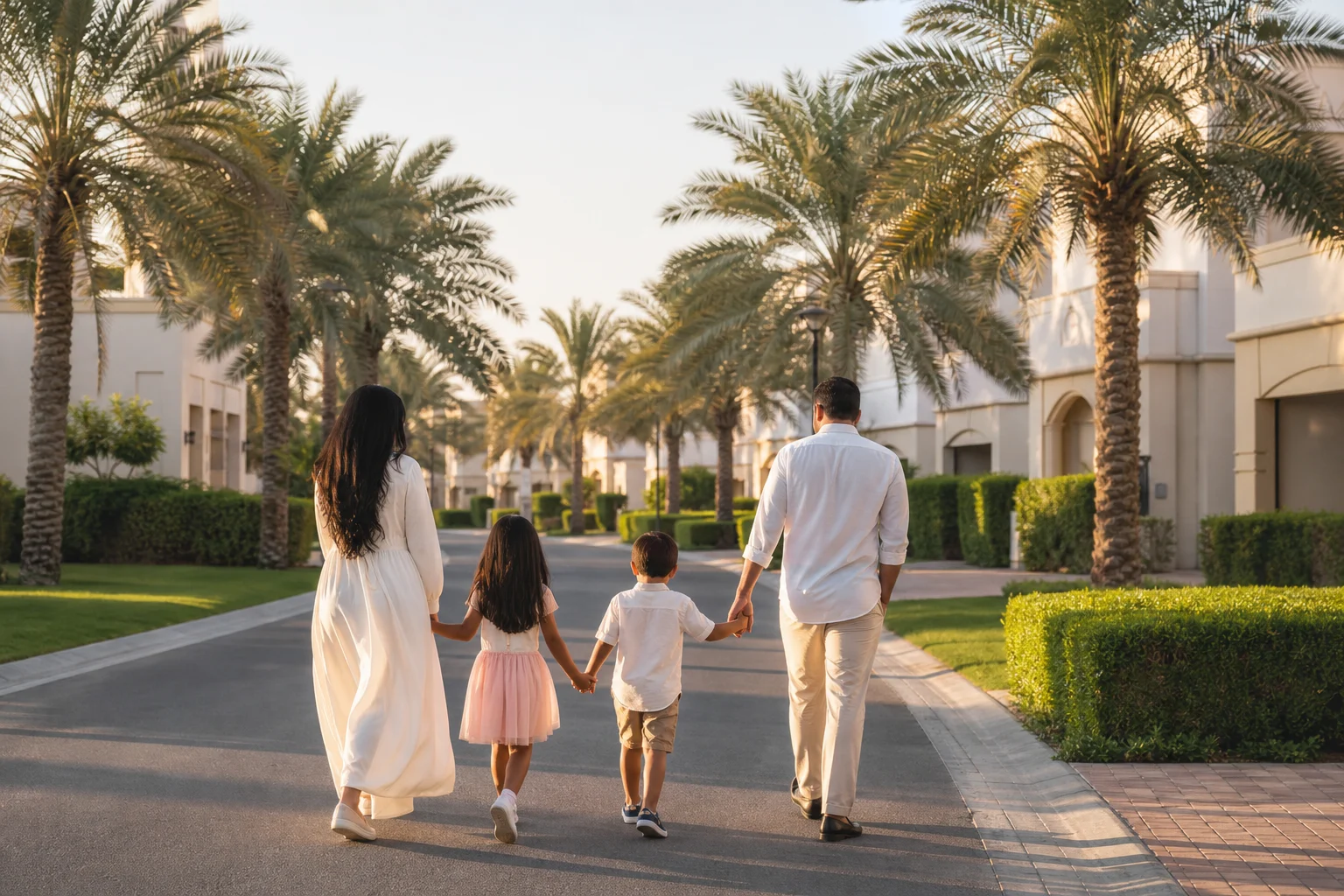
Where you live in Dubai shapes your whole experience. Get it right and family life settles quickly. Get it wrong, and the first year can feel harder than it needs to be. The school commute, the community feel, and the budget all matter. This guide walks through the main areas UK families choose, what each one offers, and what you will pay.
How to Think About Dubai Areas
Dubai is a big city, and it does not really have one centre. It has clusters. Each cluster has its own feel, its own nearby school options, and its own price range. UK families often lean toward villa communities. They want green space, good schools within 15-20 minutes, and a community feel that is at least a little like home.
The areas below come up most often for UK families. They are different enough that the right choice depends on your situation. Budget, schooling priority, commute needs, and how you spend evenings and weekends all play a part.
Renting in Dubai rather than buying gives you room to move if the area does not suit. If you do want to buy, the complete guide to buying property in UAE as a UK resident covers the full purchase process.
Curriculum choice is a separate decision. It is covered in detail in British vs IB vs American curriculum comparison for Dubai.
Jumeirah (Including Jumeirah 1, 2, 3)
Jumeirah is one of the original expat family areas. It runs along the coast west of Downtown, with a mix of older villas, beach access, and an established community feel. It is not the newest area, and some of the housing stock is dated, but it has stayed a UK family staple for 30+ years for a reason.
The location is genuinely useful. You are close to the beach, within reach of the city, and not far from DIFC and Business Bay for professionals who commute. Safa Park is right here too, which matters when you have children who need outdoor space.
Schools nearby include Jumeirah English Speaking School (JESS), Kings’ School Dubai, and Horizon School. These are among the most established British curriculum schools in Dubai, and waiting lists are real. If you are targeting these schools, start the application process before you book flights.
Rent for a three-bedroom villa runs AED 200,000-300,000 per year (roughly £43,000-£65,000). Older villas sit at the lower end. Newer or updated properties sit at the top. Apartments are cheaper, but villas are what most families want here.
Jumeirah is the right fit if you want an established community, beach proximity, and access to the most sought-after British schools. It is not the cheapest option.
Arabian Ranches
Arabian Ranches is a gated villa community built for families. It sits further inland, past Emirates Road, and that is the trade-off. You are a 30-40 minute drive from the beach and from most of the city’s commercial centres.
What it offers instead is the feel of a proper neighbourhood. Wide streets, parks, a community centre, a riding club, and a golf course nearby. Kids can cycle around. There is a supermarket and a cluster of cafes inside the development. It feels suburban in a way that appeals to UK families used to living outside city centres.
Ranches 1 is the original development and slightly more affordable. Arabian Ranches 2 and 3 are newer, have more modern finishes, and are priced accordingly.
The school on the doorstep is Jumeirah English Speaking School (JESS Arabian Ranches), a branch of the same school that runs in Jumeirah. GEMS Heritage, Ranches Primary School, and Fairgreen International are also close.
Rent for a three-bedroom villa starts around AED 160,000-200,000 per year. Four-bedroom villas go from AED 200,000-280,000. It is good value for the space you get compared with Jumeirah.
Arabian Ranches is the right fit if you want a quiet, family-first community, do not mind the distance from the beach, and want strong schools close by without Jumeirah prices.
Springs and Meadows
The Springs and Meadows are Emirates Living communities in the New Dubai corridor, clustered near Sheikh Zayed Road and Motor City. They are older developments now, but they have held up well and remain genuinely popular with UK families on mid-range budgets.
These are townhouse communities rather than standalone villas, which keeps costs lower. The layout is lake-filled and walkable in the early mornings before the heat kicks in. It is a well-established community with a mix of nationalities. Community facilities are good and schools are nearby.
Schools in range include Regent International, Dubai British School (Jumeirah Park), and Sunmarke School. All are within a short drive. These are strong British curriculum options, and they tend to have shorter waiting lists than Jumeirah schools.
Rent for a three-bedroom townhouse in the Springs runs AED 130,000-175,000 per year. Meadows villas, which are larger and more standalone, go from AED 180,000-250,000. This is one of the more affordable family options without giving up on community or schools.
Springs and Meadows suit families who want space, a real community feel, and a sensible budget. They work especially well if you do not need beach access built into daily life.
Mirdif
Mirdif sits on the eastern side of the city, close to Dubai International Airport. For families where one parent flies often, the location is genuinely convenient. It is also one of the most affordable family areas in Dubai.
It is not as polished as the New Dubai communities. The infrastructure is older and the streets are busier. But it has a loyal expat family base, a large park in Mushrif Park, and a cluster of well-regarded schools.
Schools nearby include GEMS Royal Dubai School, Uptown School, and Mirdif American Academy. Deira International School is not far away either. It has a mix of British and American curriculum options.
Rent is noticeably lower. A three-bedroom villa in Mirdif runs AED 100,000-150,000 per year. For families watching the budget closely, that matters.
The commute to the west side of Dubai, including JLT, Media City, and Dubai Marina, is the real downside. During peak hours it takes 40-60 minutes. If one or both parents work on that side of the city, Mirdif stops making sense on commute grounds alone.
Mirdif works well for families who need to be near the airport, are budget-conscious, and work on the eastern side of the city.
Dubai Hills Estate
Dubai Hills is a newer master-planned community. It has become one of the most in-demand family areas in Dubai over the last few years. It sits centrally, about 20 minutes from Downtown and 25 from Dubai Marina, which makes commuting to most parts of the city manageable.
It is green by Dubai standards. A large park runs through the middle. There are cycle paths, a golf course, and a well-developed high street with restaurants, cafes, and a mall. It feels modern and deliberate in a way that newer communities often do.
GEMS World Academy is right in the development. North London Collegiate School Dubai is nearby. Hartland International School is also close. These are premium-tier schools with fees to match.
Rent reflects the demand. A three-bedroom villa or townhouse runs AED 200,000-300,000 per year. Four-bedroom and five-bedroom properties go much higher. Apartments are more affordable, from AED 80,000-120,000 for a two-bedroom, but most families with children want the outside space.
Dubai Hills is the right fit if you want a modern, centrally located community, do not want to compromise on school quality, and have the budget to match.
JBR (Jumeirah Beach Residence) and Dubai Marina
JBR and Marina are the apartment-heavy coastal areas. Most families with young children do not settle here long term. The density, noise, and lack of private outdoor space make it a tough setting for day-to-day family life once children are past toddler age.
That said, it works for some. Single-parent families, families with older children, or families where beach access and walking to restaurants comes first. It is also a natural landing spot for the first few months. Use that time to get your bearings and figure out where you actually want to be.
Schools in the immediate area are limited. Most families commute to schools in Jumeirah or the New Dubai corridor, which adds a lot to the daily routine.
A two-bedroom apartment in JBR or Marina runs AED 130,000-200,000 per year. Three-bedroom apartments go from AED 200,000-300,000+. Good square footage does not come cheap here.
JBR and Marina are transitional areas for most families rather than permanent bases. Enjoy the first few months if you land there, but plan your permanent move in parallel.
Al Barsha
Al Barsha sits just off Sheikh Zayed Road and is central enough to be convenient for a wide range of work locations. It is one of the more affordable established areas in Dubai, and it is genuinely mixed. You will find long-term expat families alongside a broad range of nationalities.
It is not a purpose-built family community in the way Arabian Ranches or Dubai Hills is. The feel is more urban and more practical. But it has what families need: schools, parks, supermarkets, and easy road access. Al Barsha Pond Park is popular too.
Schools close by include Dubai American Academy, GEMS Al Barsha, and Wellington International School. The Mall of the Emirates is right here, which is useful rather than glamorous.
Rent is competitive. Three-bedroom villas and townhouses run AED 140,000-200,000 per year. If you want more city-adjacent living without paying Jumeirah prices, Al Barsha holds up well.
What to Prioritise When Choosing
The school question usually comes first. In Dubai, schools have waiting lists and you cannot always get into your first choice in your preferred area. Start school applications before you finalise your area decision. The school offer may dictate the area, not the other way around.
Commute is the second filter. Dubai traffic is a real factor. A 30-minute commute in light traffic becomes 60+ in peak hours. Think about where both parents work and draw a reasonable radius.
Community fit matters for the long haul. Some families want the suburban quiet of Arabian Ranches. Others want the buzz of a more active neighbourhood. Visit if you can. At least spend time in the areas before signing a lease.
Budget is the honest constraint most families underestimate. Add school fees, housing rent, insurance, and the general cost of living before deciding what you can afford in rent. The Dubai vs London cost of living comparison has the full numbers.
When your area decision is made and you are ready to move through the residency process, the UAE residence visa service handles the official paperwork from start to finish.
Frequently Asked Questions
What area of Dubai do most British expats live in?
Most British expat families live in Jumeirah, Arabian Ranches, Springs/Meadows, or Dubai Hills. Jumeirah is the original British expat hub with long-established schools. Arabian Ranches and Dubai Hills are the most popular newer family communities. The right area depends on your school preference, commute, and budget.
Which Dubai areas have the best British curriculum schools?
Jumeirah is closest to the most established British schools, including JESS and Kings’ Dubai. Arabian Ranches has JESS Arabian Ranches on the doorstep. Dubai Hills is near North London Collegiate and GEMS World Academy. Springs and Meadows have Dubai British School nearby. School waiting lists are real, so apply before finalising your area.
How much does it cost to rent a family home in Dubai?
A three-bedroom family home costs AED 100,000-300,000 per year depending on area and property type. Mirdif is at the lower end at AED 100,000-150,000. Jumeirah and Dubai Hills are at the top at AED 200,000-300,000. Springs and Meadows offer mid-range townhouses from AED 130,000-175,000.
Is it better to rent or buy a home when first moving to Dubai?
Renting is the better starting point. It gives you time to learn the city, try different areas, and move if the location does not work for your family. Buying makes more sense once you know where you want to be and plan to stay for several years. Most families rent for the first two to three years.
How important is school proximity when choosing a Dubai area?
Very important. School waiting lists in Dubai are long for the best British schools, and the school offer often determines the area, not the other way around. Apply to target schools before finalising your area decision. A long school commute through Dubai traffic weighs on daily life.